

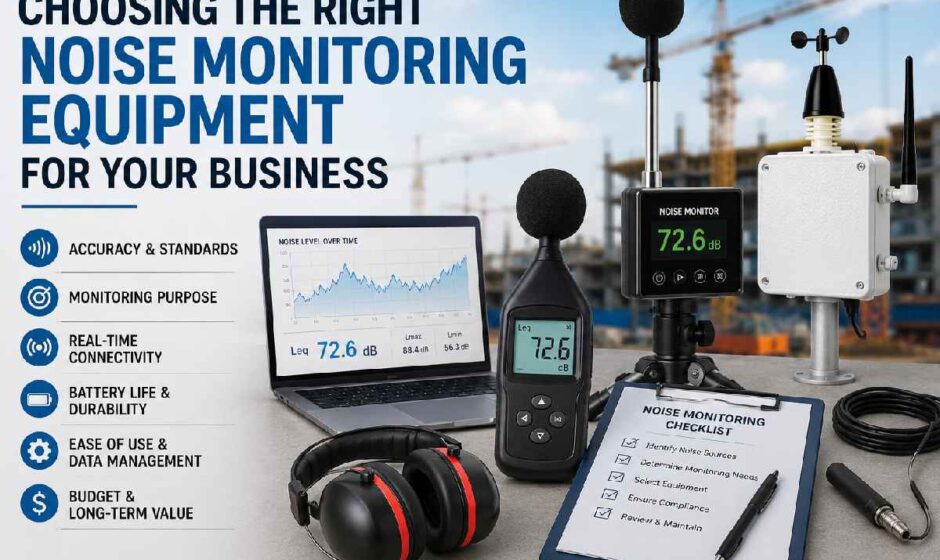

Investing in noise monitoring equipment isn’t exactly the most “obvious” expenditure priority for many businesses.
Nonetheless, from the point of view of protecting employees’ hearing, meeting legal duties, and avoiding costly claims or enforcement action, choosing the right such instruments can be hugely important.
The Importance of Noise Monitoring for Employers
Does your business operate in a sector that can present a particular risk of excessive noise to the workforce, such as manufacturing, engineering, construction, warehousing, transport, or entertainment?
If your answer to that question is “yes”, it might be especially important for your organisation to acquire sound level meters and related devices.
Such specialised instruments could help you identify elevated noise levels, investigate individual sources, support workplace noise assessments, and determine whether further control measures will be needed.
There is certainly a stringent regulatory picture in this regard. In Great Britain, for instance, the Control of Noise at Work Regulations 2005 require employers to assess and control risks from workplace noise.
The rest of this guide will be written from a UK-focused perspective, albeit still with much content and guidance of relevance to businesses elsewhere in the world.
Understand What Your Business Needs to Measure
Before you begin narrowing down your organisation’s options for noise monitoring tools, you will need to establish what the equipment will actually be used for.
If, for instance, you simply require a device for checking noise levels in a particular area, a suitable integrating sound level meter might be fine. Such an instrument may also suffice for investigating machinery, undertaking routine environmental measurements, or identifying potentially noisy processes.
Alternatively, you might already know that measurements will need to be recorded over extended periods, analysed in greater detail, or used as part of a formal occupational noise assessment. In that case, you may need to look at instruments that can provide a higher level of functionality and sophistication.
Sound Level Meters vs Personal Noise Dosimeters
Another crucial distinction to make, is between the measurement of noise in an environment and measuring an individual’s personal exposure.
It is sound level meters, or “SLMs”, that measure sound levels at a particular location. These devices are commonly categorised as one of two classes, according to the pertinent standards:
- Class 1 meters have tighter performance tolerances and are intended for more demanding acoustic measurements.
- Class 2 meters are suitable for many general workplace noise measurements and are the minimum class specified by UK Health and Safety Executive (HSE) guidance for workplace noise measurements.
SLMs should not be confused with personal noise dosimeters, which are small, wearable devices that log an individual’s exposure throughout a shift.
The latter devices can be particularly useful for mobile workers, such as forklift drivers or maintenance personnel, whose tasks and noise exposure tend to vary over the course of a day.
Summary: Matching Sound Monitoring Equipment to Your Needs
Here is an “at-a-glance” guide to the noise monitoring instruments you are likely to require for certain applications.
For:
- Routine workplace noise risk assessments, a suitable Class 2 integrating sound level meter, together with an acoustic calibrator and appropriate accessories, will normally be sufficient in many cases. A dosimeter kit could be added to this for staff in variable-exposure roles.
- Detailed assessments or hearing-protection evaluation, a meter with suitable frequency-analysis capabilities, such as octave-band measurements, may be required.
- Environmental, construction (e.g. BS 5228), or long-term monitoring, you may be well-served by a Class 1 meter with features such as data logging, weather protection, and remote access, depending on the measurement requirements.
Conclusion: An Important Step to Effective Workplace Noise Management
Whatever instrument you do eventually decide on, getting this choice right will go a long way to protecting your staff, demonstrating due diligence under UK law, and helping cultivate a safer and more productive workplace.
You will be especially well-placed to achieve these outcomes for your business when you incorporate noise monitoring into a well-designed broader approach for controlling noise.
Yes, acquiring and using suitable noise monitoring equipment can help ensure your organisation benefits from valuable information. However, you will also need to be proactive in using this information to pinpoint risks and implement the appropriate measures that will be key to protecting your staff for years to come.