

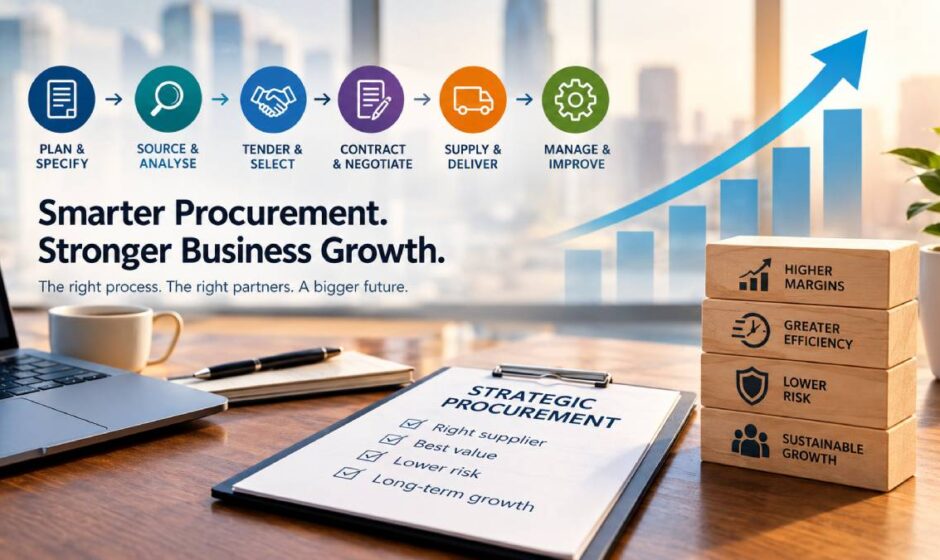

Nobody puts procurement on the slide that explains why a company grew. The credit usually lands on the product, the sales team, or a lucky piece of timing. Trace back the businesses that scaled without wrecking their margins, though, and you keep finding the same unglamorous thing underneath: somebody was paying close attention to what the company bought, from whom, and on what terms.
That attention is the whole difference between strategic procurement and plain purchasing. Purchasing reacts. A laptop dies, a team doubles in size, a support contract renews, and somebody files a request. Strategic procurement gets in front of all three, because it treats a buying decision as a commitment of cash, attention, and risk that will shape what the business can do eighteen months from now.
The gap shows up fastest in technology spend. Hardware, software seats, warranties, and shipping to remote staff compound so quietly that nobody notices until the renewal lands, and a company without a process ends up paying for the same capability two or three times over. Fix the process and the savings are real, but the better prize is speed, because teams stop waiting on things they should already have had.
Procurement as an Operating Discipline
The professional bodies have mapped this out in more detail than most companies ever use. The Chartered Institute of Procurement and Supply lays out a thirteen step procurement and supply cycle that runs from writing a specification through tendering, contract award, supplier relationship management, and finally asset management. Reading it is a useful shock, because most internal buying processes cover about four of those steps and skip the rest.
The skipped steps are where the money leaks. Specification gets written by whoever asked for the thing, so it describes a preference rather than a requirement. Market analysis never happens, so the first vendor to answer an email wins. Nobody owns performance after signature, so a supplier that quietly degrades keeps getting paid at the original rate. None of that is dramatic on its own, and that is exactly why it survives for years.
Treating procurement as a discipline means someone is accountable for the whole arc, not just the moment the invoice gets approved. That person asks what the business actually needs, checks who else in the market can supply it, and writes terms that will still make sense after the next reorganization.
Where Cost Efficiency Really Comes From
Most people assume procurement savings come from hard negotiation, and some of it does. The larger share comes from aggregation and standardization, which are far less exciting and far more durable. When five regional offices each order a different laptop model from a different reseller, the business pays five prices, holds five sets of spares, and trains support staff on five configurations. Consolidate that and the unit price falls, but the support cost falls further.
Public sector buyers worked this out decades ago and built catalogs around it. The United States General Services Administration runs its Multiple Award Schedule IT category as a pre-qualified marketplace of commercial hardware, software, and services, precisely so individual agencies stop running their own one off tenders for a laptop refresh. Private companies can borrow the logic without the paperwork: decide the standard, negotiate once, then let teams order against it.
Standardization also kills a cost that rarely appears in any budget line, which is the time senior people spend deciding things that should already be decided. A manager comparing three monitor models is a manager not doing the job you hired them for. A clear catalog with a short approval path buys that time back every week.
Allocation, Visibility, and the Cost of Guessing
Growth makes allocation harder in a way that catches leaders off guard. At thirty people, somebody remembers who has the spare dock. At three hundred, spread across four countries and a lot of kitchen tables, nobody does, and the default response to any uncertainty is to buy another one. That reflex is expensive, and it hides the real problem, which is that the business cannot see what it already owns.
Decent visibility changes the conversation from guessing to planning. If you know the age, location, and owner of every device, you can schedule refreshes instead of reacting to failures, reclaim equipment when somebody leaves, and forecast next quarter’s spend with something better than instinct. A structured approach to global it procurement gives a distributed company one playbook for sourcing, delivery, and recovery, rather than a different improvisation in every market.
Forecasting accuracy then compounds. Suppliers price certainty generously, so a company that can commit to volumes across a year negotiates from a much stronger position than one placing panic orders in week eleven of a quarter.
Supplier Relationships That Earn Their Keep
The last piece is the one companies get wrong in both directions. Squeeze every vendor to the bone and you get the service level of a customer nobody wants. Go soft and you pay for comfort. The useful middle is a small number of suppliers who understand the business well enough to flag a chip shortage before it becomes your problem, and who get held to measurable commitments in return.
Choosing those partners deserves the same scrutiny people bring to any outside specialist, with proposals compared side by side, references checked, and a shorter first commitment so performance can be proved before it gets extended. The red flags are also familiar: guaranteed outcomes, prices far below the market, and reporting that never quite arrives.
The Quiet Advantage
None of this reads like a growth strategy, which is probably why it stays available. Competitors chase channels and features while their own buying stays reactive, and the company that quietly built a real procurement function keeps a few points of margin and a lot of hours that everyone else burns.
The practical starting point is small. Pick the one category where spend is highest and visibility is worst, usually end user hardware, and fix the full cycle for that category alone: the specification, the supplier shortlist, the terms, the tracking, and the end of life plan. Do it properly once and the pattern transfers to everything else you buy.
Growth punishes improvisation. Every process that only worked because somebody remembered the details will break at the next headcount jump, and buying is usually the first to go. Getting procurement right early is not about saving a percentage on monitors. It is about making sure the thing that funds the growth is not also the thing quietly undoing it.