

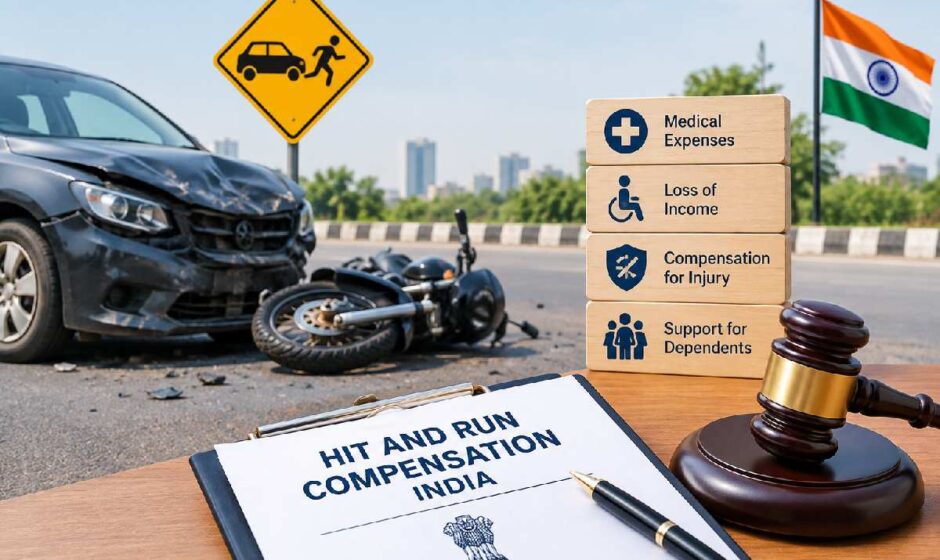

The vehicle that hit you did not stop, and by the next morning, your family was at a police station, describing a bend in the road and a number plate nobody managed to read. Motor insurance cannot help you here. A claim needs a vehicle, an owner, and a policy attached to that owner. You have none of the three.
Many websites still show the old ₹25,000 payment range, but that has changed in 2022. Right now, the government pays compensation for hit and run accidents from its special fund, for which you can apply by submitting a form to your local sub-division office. The rest of the blog explains the current hit and run payment amounts, how someone should apply for it, and some important rules everyone needs to know.
Who Pays When the Hit-and-Run Vehicle Cannot Be Traced?
Payment for hit and run cases comes from the Motor Vehicle Accident Fund, which the government maintains. Under Section 161 of the Motor Vehicles Act, 1988, the government is supposed to cover it if the offending vehicle cannot be identified despite reasonable effort by the police.
The number of cases explains why such a fund needs to exist. In its Road Accidents in India 2023 report, the Ministry of Road Transport and Highways recorded 4,80,583 road accidents and 1,72,890 deaths in that single year. Many of these drivers just drove away.
Your own policy still matters, just not for a hit-and-run accident. So it’s best to compare car insurance quotes at renewal to protect your vehicle and anyone you might injure. Protection runs outward, never back at you. If the driver who hit you runs away, the government provides the compensation instead.
How Much Is Hit and Run Compensation Worth Now?
Under the Compensation to Victims of Hit and Run Motor Accidents Scheme, 2022, death after a hit-and-run accident gives the person’s family a fixed payment of ₹2,00,000, and if you are seriously injured, you get ₹50,000. These figures have replaced the ₹25,000 and ₹12,500 paid under the old Solatium Scheme of 1989.
The fixed payment here means it is fixed. The amount paid by the government doesn’t account for the person’s salary, age, or how many family members they were supporting.
You can also get a larger settlement if the police are able to find the hit-and-run vehicle later. Here, you can file a claim against the driver’s third party car insurance in court. The government’s current compensation scheme is only for when the vehicle cannot be found.
Where Do You File the Form, and Who Moves It Next?
Form I is the application form, and it goes alongside Form IV, which is a short undertaking. Both these forms can be filed electronically by going to the Claims Enquiry Officer of the sub-division or taluka where the accident happened.
Form I asks for the place and time of the accident, the police station that registered it, an Aadhaar number, a bank passbook copy, and the injury or post-mortem certificate.
On the other hand, the police carry out their own duties. Within one month of registering a hit-and-run case, the officer in charge must tell the injured person or the family that this scheme exists, explain where to apply, and send the First Accident Report to the Claims Enquiry Officer.
Once you apply, there is a strict timeline for the processing of your application. Your Claims Enquiry Officer has one month from the date of your application to send a report to the Claims Settlement Commissioner.
The authorities have 15 days to approve the payment. Once approved, the General Insurance Council will send the money to your bank account within another 15 days. If there is a delay, they are allowed up to 30 extra days, but they must explain the reason in writing.
What the Hospital Bill Does to Your Payout
Treatment comes long before any form. Since 13 February 2026, the Prime Minister Road Accident Victims’ Hospitalisation and Assured Treatment scheme, known as PM-RAHAT, has given every road accident victim cashless care worth up to ₹1.5 lakh for up to seven days, and hit-and-run victims are included.
Whatever the hospital claimed for that cashless treatment is subtracted by the Claims Settlement Commissioner from the fixed sum. So, if the hospital bill crosses ₹2,00,000 in a death case, the family receives no cash at all.
Signing Form IV works on similar logic. You promise to return the money if the vehicle is traced later and a court now awards you compensation for the same death or injury.
What the Scheme Cannot Do for You
A fixed payment of ₹2,00,000 by the government cannot replace what the person was doing for the family, and the scheme has never tried to dismiss that. The payment does not consider ongoing medical needs, lost income, school fees, or future family expenses.
However, the process is quite easy because you don’t need to prove who is at fault, find the driver, or argue about the amount.